26 Sep 2026 XenTriX’26 • Innovate • Inspire • Elevate, A National Level Technical Symposium organized by the Departments of CIVIL, ECE, EEE & MECH at Prince Shri Venkateshwara Padmavathy Engineering College.|PRINCE சிறகுகள் 2026 – Celebrating Academic Excellence! Prince Group of Institutions honours 10th Standard students scoring 80% and above from 30 villages. 📅 27 June 2026 |PRINCE Centurion Educators Awards 2026 | Centum Result Recognition Ceremony | Honouring Principals of 100% Result Schools & Teachers Producing Centum Results | 📅 25 July 2026 | 14 th International Conference on Contemporary Engineering and Technology 2026 - 14 ICCET 2026 HYBRID CONFERENCE

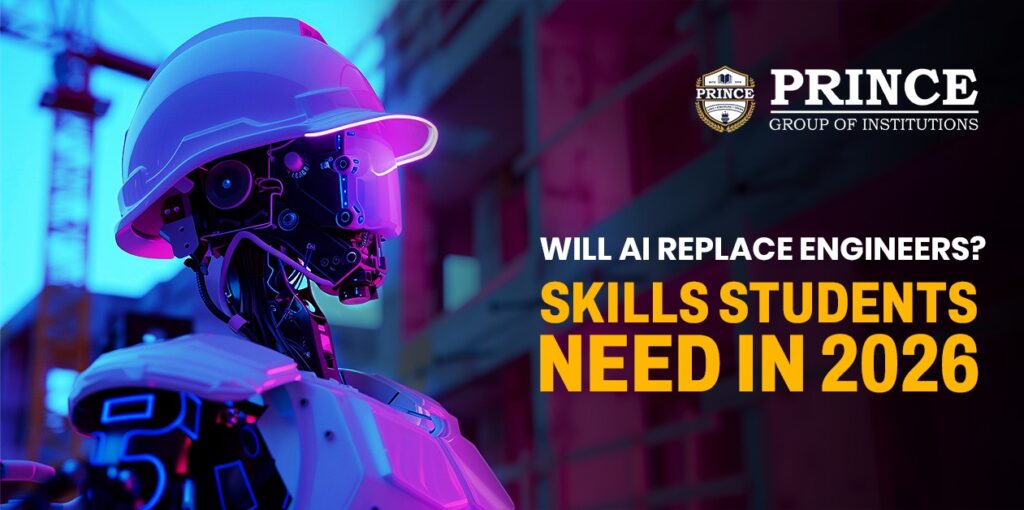
Will AI Replace Engineers? Skills Students Need in 2026

AI is becoming a force to reckon with in the engineering world in 2026. AI is now a part of daily technical tasks such as coding, data analysis, automation and design.

As a result, it is a significant question for engineering aspirants: Does AI take the place of engineers, or does it alter what engineers have to learn?

The selection of the appropriate learning environment like Prince College is now as crucial as selecting a course for students aiming to enroll in engineering courseprs for the academic year 2026–27.

Engineering is Changing – But Engineers Are Not Disappearing 

Although repetitive work can be performed using AI, engineering cannot proceed without human intervention.

Competence on the part of the engineers is expected in understanding the problem, analyzing it, and designing a system that can work under practical conditions. It is important for the student in the year 2026 to acquire skills.

Skills That Matter in 2026 

Skill

Why It Matters

AI Literacy

Helps students understand and use AI tools effectively

Problem-Solving

Helps tackle complex engineering challenges

Programming

Supports software and technology-driven careers

Data Skills

Helps analyse information and make informed decisions

Cybersecurity

Builds awareness of digital security

Communication

Helps present technical ideas clearly

Teamwork

Supports collaborative project development

Adaptability

Helps students respond to changing technologies

The Modern Engineering Learning Cycle 

  1. Learn – 2. Experiment – 3. Build – 4. Test – 5. Improve – 6. Present – 7. Apply

With this approach students can:

  • Understand concepts practically
  • Develop technical confidence
  • Find solutions to problems in the real world..
  • Improve teamwork
  • Develop presentation skills

AI, Data and Cybersecurity are Changing the Technology Landscape 

There are various developing fields that students can investigate along the way during their engineering career.

Key Technology Areas

  • Artificial Intelligence
  • Machine Learning
  • Data Science
  • Cloud Computing
  • Cybersecurity and more.

Core Engineering + Emerging Technology = The New Advantage 

Engineering Area

Possible Technology Connection

Mechanical Engineering

AI, automation and smart manufacturing

Civil Engineering

Data-driven infrastructure and planning

ECE

IoT, embedded systems and connected devices

EEE

Automation, smart energy and control systems

CSE

AI, cloud, data and software solutions

Why Internships Matter in 2026 

Internship provides an insight into how that knowledge is applied in practice.

Prince College stresses the importance of internships as a great opportunity for students to gain practical experience and learn about the current trends in the industry.

Hackathons: Where Students Learn Under Pressure 

The sequence should be: Problem, Idea, Prototype, Testing, Presentation.

Hackathons can be used to help students learn:

  • Creativity
  • Quick decision-making
  • Problem-solving
  • Teamwork
  • Technical skills and more.

Prince College (PSVPEC) emphasizes hackathons as a tool to tackle actual problems and build teamwork, creativity and industry awareness.

Research and Innovation

The research thinking can be introduced to students at college level projects and innovation activities.

PSVPEC also calls attention to Centres of Excellence, such as MIRACLE – Modern Innovation & Robotics Centre for Learning and Excellence and the Centre for Computational Bio-Photonics and Smart Systems (CCBSS).

It can be highly advantageous for students that wish to engage themselves in research and advanced studies, start-up ventures, and innovation-based careers.

Check out, How Prince College Shapes Career-Ready Engineering Graduates 

A Four-Year Career Preparation Roadmap

Year

Student Focus

1st Year

Build fundamentals and communication skills

2nd Year

Explore technology and technical activities

3rd Year

Focus on internships, projects and hackathons

4th Year

Strengthen placement and career preparation

Conclusion

Technology literacy, problem-solving and project building skills and the ability to learn and use new tools will benefit students for the future.

The present educational landscape within Prince College incorporates these aspects into academics, hands-on learning, Industrial visits, Projects, Hackathons, Research and Placement oriented activities.

Admissions Open 2026-27!

FAQs

  1. Will AI replace engineers in the future?
  • AI likely won’t replace engineering jobs but replace them in many ways. AI awareness is essential, as are technical and problem-solving abilities, for engineers in the future.
  1. What are the skills engineering students should acquire in 2026?
  • The important competencies are communication, collaboration and adaptability, problem solving, data skills, coding, and AI skills.
  1. What is the value of an internship for engineering students in Prince College?
  • Internships offer hands-on experience and bring into students’ awareness the application of engineering concepts in a professional setting.
  1. In what ways can hackathons help engineering students?
  • Hackathons are events that help students build presentation, technical, teamwork, and creative skills; and are designed to give students a well-chosen problem to solve in a set amount of time.
  1. What is the number of branches of engineering?
  • Students should think about academic life, labs, internships, projects, industry exposure, emerging technologies, research and hackathons, placement preparation etc. in choosing the course.

Source

Blog Created By Ghowthami M

Images Designed  by Photoshop

Prince College  Official Website – https://psvpec.in/, https://www.thehindu.com/, https://www.indiatoday.in/ & https://timesofindia.indiatimes.com/ 

Leave a Comment

Your email address will not be published. Required fields are marked *

Scroll to Top

DIRECT SECOND YEAR (B.E./ B.TECH) PROGRAMS- LATERAL ENTRY

Diploma Candidates :

A pass with minimum eligibility marks in one of the Diploma Courses in Engineering / Technology of the State Board of Technical Education and Training, Tamil Nadu / Equivalent prescribed for the respective Degree Courses.

B.Sc Candidates :

A pass with minimum eligibility marks in any recognized Bachelor’s Degree in Science with minimum 3-years duration with (10+2+3) pattern of study with Mathematics as one of the subjects at the Degree level.

MINIMUM ELIGIBILITY MARKS

The candidates should have obtained the following marks in the qualifying examination, Diploma/ B.Sc for eligible to admission.

  • For candidates belonging to Other Communities (OC): -A minimum average of 55.00% in the Pre-final and Final semesters put together.
  • For candidates of BC & BC (Muslims) Communities: – A minimum average of 50.00% in the Pre-final and Final semesters put together.
  • For candidates of MBC & DNC Communities: – A minimum average of 45.00% in the Pre-final and Final semesters put together.
  • For candidates of SCA/SC/ST Communities: – A mere pass in the qualifying examination which is same as the passing minimum for Diploma examination of the State of Technical Education and Training, Tamil Nadu/ B.Sc Degree Examination of Universities.
  • (In case of candidates studied in annual pattern, marks obtained by them in the final year shall be taken into account for arriving minimum eligibility marks).

POST-GRADUATE PROGRAMS (M.C.A/M.B.A)

M.C.A.

A pass in a recognised Bachelor’s degree of minimum 3 years duration with mathematics at 10+2 level or at Graduate level and obtained at least 50 %(45 % in the case of candidates belonging to reserved category) in the qualifying degree examination.

(a)10+2+3/4 years Pattern
(or)

(b)10+3 years diploma + 3 years Pattern
(or)

(c) (i)10+2+AMIE*
(or)

(ii) 10+3 Years diploma (awarded by the State Board of Technical Education) + AMIE.

M.B.A

A pass in a recognised Bachelor’s degree of minimum 3 years duration and obtained at least 50 % (45 % in the case of candidates belonging to reserved category) in the qualifying degree examination

(a) 10+2+3 years pattern
(or)

(b) 10+3 years Diploma + 3 years pattern
(or)

(c) B.E./B.Tech./B.Arch./B.Pharm.
(or)

(d) (i) 10+2+AMIE*
(or)

(ii) 10+3 Years diploma (awarded by the State Board of Technical Education) + AMIE.

M.C.A.(Lateral Entry)

A pass in a recognised Bachelor’s degree of minimum 3 years duration in BCA, B.Sc. (Information Technology /Computer Science) with mathematics as a course at 10+2 level or at Graduate level and obtained at least 50 %(45 % in the case of candidates belonging to reserved category) in the qualifying degree examinations.

(a)10+2+3 years Pattern

UNDER-GRADUATE PROGRAMS(B.E./ B.TECH).

1. (10+2)/ HSC (Academic) or Equivalent

  • For candidates belonging to Other Communities (OC) of Tamil Nadu State: a minimum average of 50% in Mathematics, Physics and Chemistry.
  • For candidates of Backward class Community (BC) and BC (Muslims) of Tamil Nadu State: a minimum average of 45% in Mathematics, Physics and Chemistry.
  • For candidates of Most Backward class Community (MBC) & DNC of Tamil Nadu State: a minimum average of 40% in Mathematics, Physics and Chemistry.
  • For candidates of SCA/SC/ST community of Tamil Nadu State: a mere pass with Mathematics, Physics and Chemistry.

2. HSC (Vocational) :

  • For candidates belonging to Other Communities (OC) of Tamil Nadu State: a minimum average of 50% in the related subjects and Vocational subjects (theory and practicals)
  • For candidates belonging to Backward class Community (BC) and BC (Muslims) of Tamil Nadu State: a minimum average of 45% in the related subjects and Vocational subjects (theory and practicals)
  • For candidates belonging to Most Backward class Community (MBC) & DNC of Tamil Nadu State: a minimum average of 40% in the related subjects and Vocational subjects (theory and practicals)
  • For candidates belonging to SCA/SC/ST Community of Tamil Nadu State: a mere pass in the related subjects and Vocational subjects (theory and practicals)