
EDUFUSION LEADERSHIP SUMMIT 2026 • 31st January 2026 • A Premier Gathering of School Leaders & Visionary Educators | GLOBAL SEMICONDUCTOR NEXUS (GSN 2026) – International Conference in Collaboration with Taiwan | Organized by the ECE Department | 10–11 July 2026 | Prince iSOLVE Hack ’26 – National Level Hackathon | Jointly Organized by Department of ECE, Department of EEE, and Tinkerers’ Lab | Scheduled on 21 February 2026 | Registration Opens Soon |14 th International Conference on Contemporary Engineering and Technology 2026 - 14 ICCET 2026 HYBRID CONFERENCE

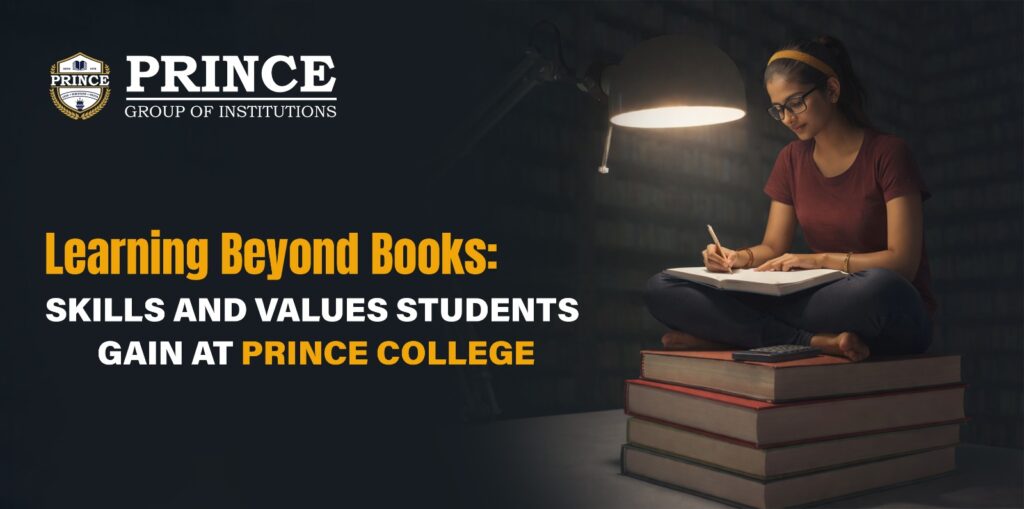
Learning Beyond Books: Skills and Values Students Gain at Prince College

Finding the right college is not just a matter of academics but it is a matter of development, experience, and preparing one to live beyond the campus. At Prince Shri Venkateshwara Padmavathy Engineering College (Prince College), the students do not just study by reading a book, they learn in a way to be innovative, a leader and an adaptive learner to the dynamic world they live in. Prince College has a solid emphasis on holistic growth, as the college prepares its students mentally.

Learning Beyond Textbooks at Prince College

Although the textbooks offer the basics of the theories and concepts, Prince College does not want students to merely memorize the facts; they have to think critically and put in practice what they study practically. The project-based learning, laboratory work, industry partnerships, and the interactive classroom lessons, allow cultivating the young minds to think analytically and learn how to divide the problems with intricate nature into feasible solutions.

Industry-Relevant Technologies and Exposure

The world is evolving at a fast rate, and nowadays the employers seek out graduates who are already aware of the latest tools and technologies. Prince College makes sure that students are introduced to such new areas as Artificial Intelligence, Data Science, Machine Learning, and the Internet of Things (IoT). Instead of students depending on textbooks, practical laboratory classes and workshops have their hands on knowledge. Students learn technologies that are in demand hence they are ready to have internships and placements even in their first semesters.

Innovation and Curiosity

Innovation is not an aspect which can be learnt in a chapter, it is rather fostered by an atmosphere which promotes exploration. Prince College fosters innovation by offering students the prospects to join hackathons, code competitions and research, and idea incubators.

Communication and Interpersonal Skills

An engineer/manager/technologist should be a good communicator. Prince College not only goes beyond the academic education but also directs its attention to other soft skills like leadership, teamwork, presentation, and communication with people.

The interactive workshops, group discussions, speech events and industry talks assist the students to be sure of their speaking skills and this quality makes them more presentable and employable. The experiences also guarantee students the ability to express themselves clearly, as well as operate effectively within a team environment.

Corporate Readiness and Professionalism

Professionalism is acquired with experience, technical knowledge may be provided through textbooks. In Prince College, the Training and Placement Cell participates in:

  • Resume building sessions
  • Mock interviews
  • Group discussion practices
  • Preparation programs in the industry.

The activities get the students ready to meet similar recruiters with confidence, interview techniques, and knowledge of expectations in the workplace. Real world career training plays a part in reducing the gap between academic learning and corporate requirements.

Teamwork and Leadership

Prince College is focused on group learning. The students often do team work, work in groups, and participate in various clubs where they learn how to cooperate with a variety of peers. Leadership skills are developed through these experiences who organize projects, lead teams and schedule.

Project management skills, conflict management skills, organization skills, among others, are taught to individuals through student clubs, committees, and culture events, which would be very important in workplaces through teamwork, which characterizes success.

Lifelong Learning Mindset

Lastly, another greatest lesson that students learn at Prince College is the practice of lifelong learning. In the transforming modern world, education is not completed after graduation, technology is developed every month, and the industry is changing every day.

Frequently Asked Questions

  1. What are the types of skills that the students acquire in Prince College other than academics?

Students learn critical thinking, problem solving, communication, teamwork, leadership and professional preparedness- all these are things they cannot learn in a textbook.

  1. Is there real-life exposure to technologies in Prince College?

Yes. The college incorporates industry-related technologies such as AI, Data Science, and Internet of Things into its practical learning in terms of laboratories, workshops, and real-world projects.

  1. What does Prince College do to develop soft and communication skills?

Students improve their confidence, communication skills through interactive classes like presentations, group discussion, seminars, and guest talks.

  1. Do students get incentive to be innovative and do research?

Definitely. Students are involved in hackathons, research work, group work and innovation hubs where they are challenged to think and seek solutions.

  1. What is the role of Training and Placement Cell in Prince College in career growth?

Placement Cell has resume workshops, mock interviews, technical and soft-skill training to prepare the students in the corporate setups and interviews.

Leave a Comment

Your email address will not be published. Required fields are marked *

Scroll to Top

DIRECT SECOND YEAR (B.E./ B.TECH) PROGRAMS- LATERAL ENTRY

Diploma Candidates :

A pass with minimum eligibility marks in one of the Diploma Courses in Engineering / Technology of the State Board of Technical Education and Training, Tamil Nadu / Equivalent prescribed for the respective Degree Courses.

B.Sc Candidates :

A pass with minimum eligibility marks in any recognized Bachelor’s Degree in Science with minimum 3-years duration with (10+2+3) pattern of study with Mathematics as one of the subjects at the Degree level.

MINIMUM ELIGIBILITY MARKS

The candidates should have obtained the following marks in the qualifying examination, Diploma/ B.Sc for eligible to admission.

  • For candidates belonging to Other Communities (OC): -A minimum average of 55.00% in the Pre-final and Final semesters put together.
  • For candidates of BC & BC (Muslims) Communities: – A minimum average of 50.00% in the Pre-final and Final semesters put together.
  • For candidates of MBC & DNC Communities: – A minimum average of 45.00% in the Pre-final and Final semesters put together.
  • For candidates of SCA/SC/ST Communities: – A mere pass in the qualifying examination which is same as the passing minimum for Diploma examination of the State of Technical Education and Training, Tamil Nadu/ B.Sc Degree Examination of Universities.
  • (In case of candidates studied in annual pattern, marks obtained by them in the final year shall be taken into account for arriving minimum eligibility marks).

POST-GRADUATE PROGRAMS (M.C.A/M.B.A)

M.C.A.

A pass in a recognised Bachelor’s degree of minimum 3 years duration with mathematics at 10+2 level or at Graduate level and obtained at least 50 %(45 % in the case of candidates belonging to reserved category) in the qualifying degree examination.

(a)10+2+3/4 years Pattern
(or)

(b)10+3 years diploma + 3 years Pattern
(or)

(c) (i)10+2+AMIE*
(or)

(ii) 10+3 Years diploma (awarded by the State Board of Technical Education) + AMIE.

M.B.A

A pass in a recognised Bachelor’s degree of minimum 3 years duration and obtained at least 50 % (45 % in the case of candidates belonging to reserved category) in the qualifying degree examination

(a) 10+2+3 years pattern
(or)

(b) 10+3 years Diploma + 3 years pattern
(or)

(c) B.E./B.Tech./B.Arch./B.Pharm.
(or)

(d) (i) 10+2+AMIE*
(or)

(ii) 10+3 Years diploma (awarded by the State Board of Technical Education) + AMIE.

M.C.A.(Lateral Entry)

A pass in a recognised Bachelor’s degree of minimum 3 years duration in BCA, B.Sc. (Information Technology /Computer Science) with mathematics as a course at 10+2 level or at Graduate level and obtained at least 50 %(45 % in the case of candidates belonging to reserved category) in the qualifying degree examinations.

(a)10+2+3 years Pattern

UNDER-GRADUATE PROGRAMS(B.E./ B.TECH).

1. (10+2)/ HSC (Academic) or Equivalent

  • For candidates belonging to Other Communities (OC) of Tamil Nadu State: a minimum average of 50% in Mathematics, Physics and Chemistry.
  • For candidates of Backward class Community (BC) and BC (Muslims) of Tamil Nadu State: a minimum average of 45% in Mathematics, Physics and Chemistry.
  • For candidates of Most Backward class Community (MBC) & DNC of Tamil Nadu State: a minimum average of 40% in Mathematics, Physics and Chemistry.
  • For candidates of SCA/SC/ST community of Tamil Nadu State: a mere pass with Mathematics, Physics and Chemistry.

2. HSC (Vocational) :

  • For candidates belonging to Other Communities (OC) of Tamil Nadu State: a minimum average of 50% in the related subjects and Vocational subjects (theory and practicals)
  • For candidates belonging to Backward class Community (BC) and BC (Muslims) of Tamil Nadu State: a minimum average of 45% in the related subjects and Vocational subjects (theory and practicals)
  • For candidates belonging to Most Backward class Community (MBC) & DNC of Tamil Nadu State: a minimum average of 40% in the related subjects and Vocational subjects (theory and practicals)
  • For candidates belonging to SCA/SC/ST Community of Tamil Nadu State: a mere pass in the related subjects and Vocational subjects (theory and practicals)