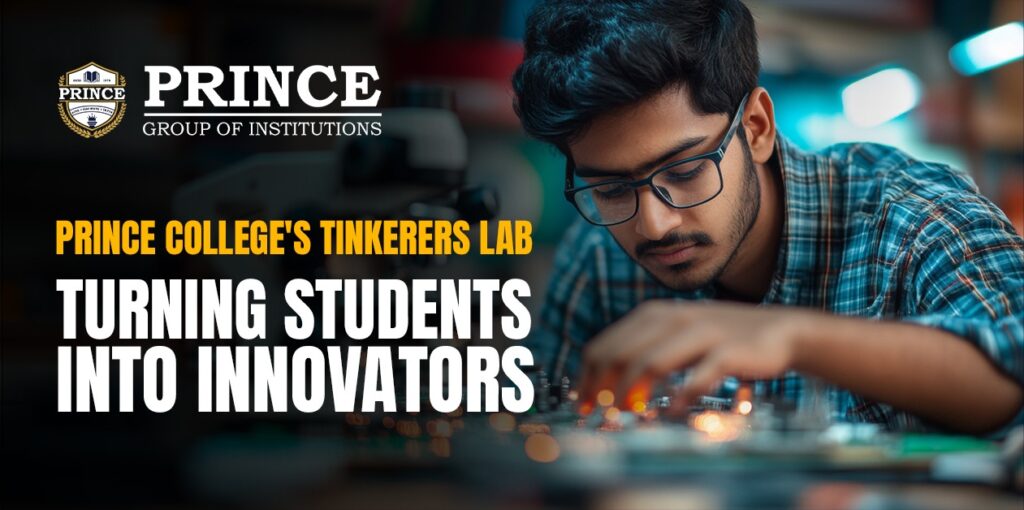
The modern world is technology-driven and engineering students require more than just theoretical knowledge to excel. Industries look for graduates that are innovative, can solve actual problems, can create prototypes and can be flexible enough to apply to new technologies.
In Prince Engineering College, the Tinkerers Lab is a place for creativity, innovation and learning through experience. It gives students the opportunity to take ideas and teaches the technical and professional skills needed for modern industry.
Why Innovation Learning Matters in Engineering Education
Classroom learning is no longer the only way to learn engineering. The students should be expected to implement concepts, make solutions and solve real world problems.
Advantages of Innovation-Based Learning
Learning Component | Student Benefit |
Hands-on Projects | Practical application of engineering concepts |
Innovation Activities | Creative problem-solving skills |
Prototype Development | Product design and development experience |
Industry Exposure | Understanding industry requirements |
Team Collaboration | Leadership and communication skills |
In the Tinkerers Lab, learners have the chance to play around with new technological advancements and solve existing issues.
How Does the Tinkerers Lab Promote Practical Innovation?
Tinkerers Lab enables students to explore emerging technologies and develop solutions to the current challenges.
Opportunities for Students To:
- Build prototypes
- Participate in innovation challenges
- Work on interdisciplinary projects
- Explore product development
- Engage in design thinking activities
- Develop entrepreneurial skills
These experiences build confidence in the application of engineering concepts outside of textbooks.
Hands-on Learning via Practical Projects
The most significant advantage of the Tinkerers Lab is hands-on learning via practical projects.
Major Domains of Students’ Engagement
| Project Area | Learning Outcome |
| Robotics and Automation | Automation and control systems knowledge |
| Internet of Things (IoT) | Smart connected device development |
| Artificial Intelligence Applications | Intelligent system design |
| Product Design and Development | Prototype creation and product innovation |
| Smart Technology Solutions | Technology-based problem solving |
| Sustainable Engineering Projects | Environmentally responsible innovations |
The building industry is using WBL to develop these skills, which are relevant to their industry.
Industry-Relevant Skills Developed Through Tinkerers Lab
Skill Area | Outcome |
Technical Skills | Industry readiness and practical expertise |
Design Thinking | Innovative problem-solving abilities |
Teamwork | Enhanced collaboration and coordination |
Communication Skills | Effective project presentation capabilities |
Leadership | Project management and decision-making skills |
These kinds of skills are important additions which prepare the students for their professional life and future jobs.
Promoting Entrepreneurship and Innovation
Innovation Fostering Via:
- Exploring Innovative Solutions
- Developing Working Models
- Finding Practical Solutions to Real World Problems
- Cultivating Entrepreneurial Spirit
Such an atmosphere makes students future innovators, entrepreneurs, and technological leaders.
Learning Through Industry Interaction
It serves as a link between the academic and industry world through its meaningful interaction with industries.
Opportunities Available to Students
- Technical workshops
- Innovation boot camps
- Expert mentoring sessions
- Industry interactions
- Project exhibitions and showcases
- Technical competitions
Such tasks make students aware of the latest developments and practices in the industry.
Impact of Tinkerers Lab on Student Development
Focus Area | Student Transformation |
Innovation | Creative thinking and ideation |
Technical Knowledge | Practical engineering expertise |
Problem Solving | Real-world solution development |
Leadership | Project ownership and management |
Entrepreneurship | Startup and business awareness |
Career Readiness | Industry preparedness |
Conclusion
Tinkerers Lab at Prince Engineering College is a significant part in nurturing young engineers with innovation, creativity and experiential learning.
Students are confident and competent to thrive in today’s engineering world, using project-based learning, industry connections and technology-based exploration.
FAQs
- What is Tinkerers Lab at Prince Engineering College?
- Tinkerers Lab is an innovation & experiential learning lab for students to do projects, prototypes & emerging technologies.
- What are the advantages for students taking part in the Tinkerers Lab?
- It enables students to acquire practical skills, innovative capabilities, team working and problem solving skills in hands-on learning.
- What kinds of projects are available for students to do?
- This offers students an opportunity to learn through various topics including robotics, IoT, product development, applications of artificial intelligence, automation systems and other technology based innovations.
- Is the Tinkerers Lab an entrepreneurial endeavor?
- It is a center that helps the students in creative thinking, prototype making, and entrepreneurship.
- How does the Tinkerers Lab help create career opportunities?
- It helps increase employability because of practical experience, technical skills, portfolio of projects, and industry-related education.
Source
Blog Created By Ghowthami M
Images Designed by Photoshop
Prince College Official Website – https://psvpec.in/, India Today & Times of India.